

Shooting Disciplines and Ranges
Target Rifle
Traditionally known as “Full Bore”; Target Rifles are single shot, bolt action, 308 (or 5.56) calibre, fired from a prone position. Rifle stocks are made of wood or aluminium and can be adjusted to suit the shooter’s comfort and preferences. A sling is used to support the shooters arm and rifle in a triangle configuration. The most significant difference Target Rifle has with other shooting sports is the use of a rear “peep” sight and a ring foresight. Each has a small aperture, usually adjustable in size, when firing they are lined up to aim at the target. The rear peep sights are adjustable to allow for firing distance, wind strength and direction. A very simplified description, but it is said that sighting through a small aperture enhances the eye’s ability to focus on a single object, in rifle shooting the object is the target’s aiming mark.
Scoring
Each distance has specified dimensions for the aiming mark and each scoring ring. A standard application is two sighting shots and ten counting shots. The score for the sighting shots can be kept if they are good or deleted if they are bad.
The highest score for Target Rifle is the bullseye = 5 points and V bull = 5.1. The best “possible” score over 10 shots is 50.10.
Hunting Class:
Open to any rifle bought as a standard factory-made sporting /hunting rifle. Shot over 300 to 1000 yards.
Interested – Come along to Wurgabup and try your gear out, will your hunting rifle hit a bullseye?
The range has upgraded from older Kongsberg systems to four advanced, open-sensor Silver Mountain Targets (SMT) that use acoustic technology to instantly plot impact within millimetres. This modern, wireless, open-air system allows shooters to instantly view shot data, group sizes, and scores on their own smartphones, tablets, or laptops.
Shooting Range
The firing points (mounds) at Wurgabup are at distances of 300, 400, 500, 600, 700, 800, 900 and 1000 yards. A well designed mound has a slight gradient to facilitate the shooters firing position in relation to the target.
Targets
Electronic targets are a significant development in long range shooting.The face of the target is a membrane that has the ability to contract after the projectile has passed through. Sensors fitted to the target detect within millimetres the point of a projectile’s impact. The data is sent wirelessly to a monitor screen for the shooter to view the position of every shot and the resulting score.

KRONSBERG TARGET SYSTEM
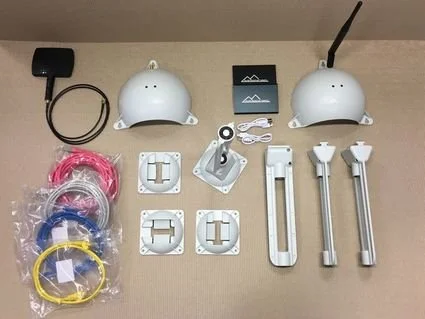
Silver Mountain Targets (SMT)
F-Standard - F-Open - FTR
F-Standard, F-Open and FTR scoring the V bull is scored as 6 and an X is a score of 6.1, the best “possible” score over 10 shots is 60.10. F-Class disciplines have been included in
the NRAA Standard Shooting Rules since 2003 but it has only been the in last five years that it has gained in popularity.
Initially seen as an option for people no longer physically or optically able to continue in Target Rifle. But the ease of taking up F-class and the challenge of getting all facets technically correct to achieve the elusive X ring has caught many people’s imagination. In a recent NRAA report up to 30% of Prize Meeting attendances are F-Class competitors, and growing. And indeed 90% of Wurgabup’s membership compete in F-Standard.
F-Standard and F-Open rifles are mounted with telescopes and use either a front tripod stand or both a rear rest and a fore-rest. The shooter lies on a ground sheet but has no need of a shooting jacket, but may wear a hat. The bullet caliber for F-Standard is 308 or 5.56, whereas for F-Open any caliber up to 8mm may be used.
Follow the National Rifle Association of Australia link on the bottom of this page to access the Standard Shooting Rules.

SSAA’s shooting competitions - commonly referred to as ‘disciplines’ - include the use of many different types of firearms such as shotguns, pistols, revolvers and rifles in rimfire, centrefire, air and black powder, and a variety of target configurations, depending on the discipline and relevant competition rules.
SSAA has developed rules for shooting events across a range of disciplines, including the SSAA Standard Rules and other guides. The SSAA Standard Rules are common to all SSAA disciplines and the current version of the SSAA Standard Rules has precedent over the relevant rules in a SSAA discipline rule book. All current SSAA rule books are available on the WA SSAA website.
Shot Gun
Clay competitions are the fastest growing of the shotgun disciplines. One such discipline is 5-Stand Sporting Clays. It is designed to simulate field shooting of waterfowl and other game in a natural setting. Traps can be set up in a relatively small area. In this sport, shooters move between five firing points or ‘stands’ in the layout and are presented with five targets at each stand. 5-Stand trap placement and target trajectory can be varied from course to course.
While many shotguns can be used successfully, the most popular choice is a 12-gauge over-and-under with 26” to 30” barrels. It should have a single trigger, sporting stock and fore-end, selectable barrels and interchangeable choke tubes. Many shooters find a combination of quarter and half chokes will suit the majority of targets at most clubs.
Hand Gun
The main types of handguns used include self-loading pistols and revolvers, with calibres ranging from .22 to 357. There are four divisions for Handgun shooting: Open, Standard, Production and Revolver.
Open division comprises full house race guns; these are heavily modified firearms with red dot optic sights, compensated barrels, worked trigger systems and oversized controls.
Standard division has always been considered the traditionalist’s division. While many competitors choose to keep the steel sights, modifications to the firearm are permitted as long as they are within the limitations and measurements of the rules.
Rim Fire Rifle
This competition is a great one to get started in as it appeals to all, especially the younger shooters. It is score shooting with targets at 50m and 100yards.
A target has scoring rings 10, 9, 8, 7, and 6. The centre dot of the 10 ring is an X hit. Top score is 50.5 per target. A full match consists of 25 record shots (that's 5 targets) at 50m and 25 record shots (another 5 targets) at 100yds. Each target has a 7 minute time limit and has an area for sighter (practice) shots contained within the square area required.
The Mandar match is divided up into 5 stages for a total of 48 rounds.
They are fired at distances from 10 metres out to 25 metres using different rates of fire with turning targest set at different times.
After each stage all targets are scored and then patched ready for the next stage.
The course of fire in Mandar is always the same, giving competitors ample opportunities to really hone their skills. Tied Mandar matches do not utilise a count back to identify a winner. The target has an "X" ring and the winner is determied by the "X" count if there is a tied match. If the score and "X" count are the same then competitors are required to simultaneously repeat the last course of fire under a reducing time until one competitor posts a winning score, this is known as a “shoot off”. Mandar shoot offs are intense and challenging demonstrations of absolute precision under extreme stress, they are great to watch as well as compete in.
In Mandar, you can use a Revolver or Semi-Automatic Pistol with or without optical aids or you can go all out and use a fully customised handgun. Experienced Mandar shooters will typically tune their equipment to produce pinpoint accuracy.
There are 4 x different divisions in Mandar so you will all be shooting with similar firearms.
The same pistol must be used to complete the match from start to finish.
CREDIT TO https://www.ssaawa.org.au/disciplines/mandar
Benchrest
Benchrest shooting is a rifle sport, where the shooter attempts to place five or ten shots into the smallest possible group at varying distances. Benchrest tests the accuracy of the rifle, ammunition and the shooter's skills, particularly with regard to position; technique and reading of conditions.
It aims to encourage competition in order to achieve extreme accuracy in firearms, ammunition, equipment and shooting methods. Participants are encouraged to explore the design limits of firearms hardware. After beginning by shooting with standard rifles and ammunition, many shooters set forth on a personal voyage in pursuit of extreme accuracy. In doing so they develop new hardware, adopt better shooting techniques and gain personal satisfaction.
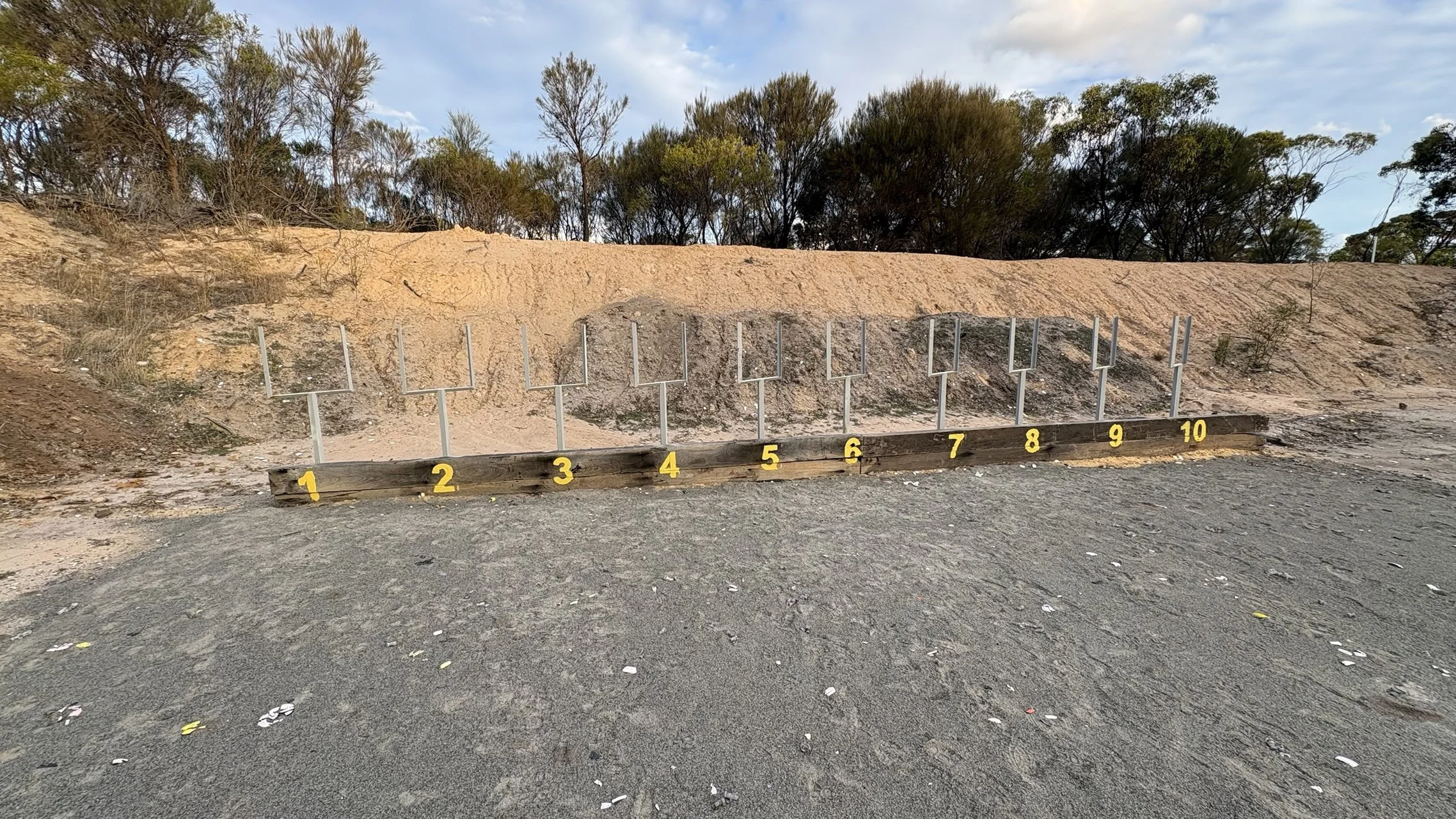
newley modified turning target rack for mandar.
